If you’ve ever put on sunscreen and felt your face start to burn within thirty seconds, you already know the frustration. You want to protect your skin. You just don’t want to trade sun damage for a rash.
That tension is exactly why “sensitive skin” and “sunscreen” get typed into Google together so often. The good news: the problem usually isn’t sunscreen itself — it’s the type of sunscreen and a handful of specific ingredients that tend to cause trouble. Once you know what to look for, this gets a lot easier.
🖼️ QUICK SUMMARY BOX
- Who this guide is for: Anyone with reactive, eczema-prone, rosacea-prone, or easily-irritated skin who needs daily SPF
- Best overall pick: A fragrance-free mineral (zinc oxide) sunscreen, SPF 30 or higher
- Budget-friendly pick: A drugstore mineral formula with a short, simple ingredient list
- Key takeaway: Mineral sunscreens with zinc oxide as the primary active ingredient cause the fewest reactions in sensitive skin, but formulation matters as much as the active ingredient itself
- Estimated reading time: 9–10 minutes

Why Sunscreen Irritates Sensitive Skin in the First Place
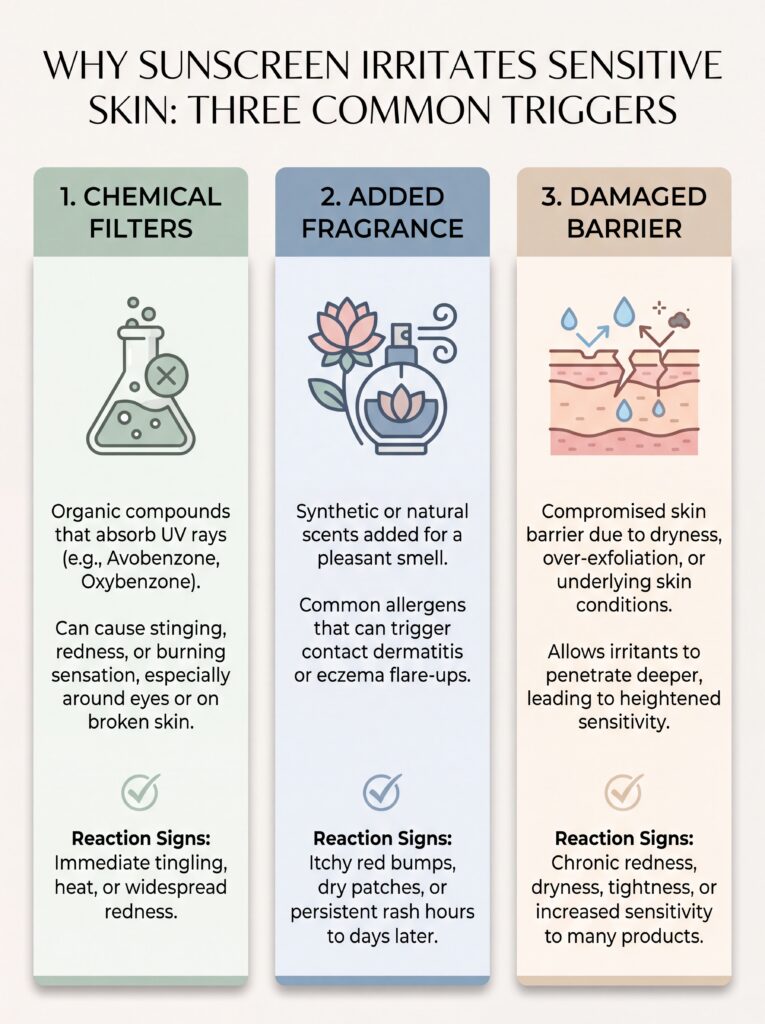
Before picking a product, it helps to understand what’s actually going on. Most reported sunscreen reactions trace back to one of three causes, not the SPF itself.
1. The filter type. Sunscreens use either chemical (organic) filters like oxybenzone, avobenzone, and octinoxate, or mineral (inorganic) filters like zinc oxide and titanium dioxide. Chemical filters absorb UV rays and convert them to heat; mineral filters sit on top of skin and reflect/scatter UV rays. That absorption process is where a lot of stinging and flushing originates, especially around the eyes and on already-compromised skin barriers.
2. Fragrance and preservatives. Added fragrance is one of the most common triggers for contact dermatitis in skincare generally, and sunscreen is no exception. Alcohol-based sprays can also worsen dryness and stinging on eczema-prone skin.
3. A damaged skin barrier. If your barrier is already compromised — from eczema, over-exfoliation, or rosacea — almost any active ingredient can penetrate more easily and trigger a reaction, even ingredients that wouldn’t bother “normal” skin.
Expert Tip: If you’re not sure whether it’s the sunscreen or something else causing a reaction, patch test on your inner forearm for 48 hours before applying anything new to your face.
Mineral vs. Chemical Sunscreen: What Sensitive Skin Should Know
This is the single most important decision for reactive skin.
Mineral (physical) sunscreens use zinc oxide and/or titanium dioxide. They sit on the skin’s surface and are generally considered the gentler option because they don’t need to be absorbed to work. Zinc oxide in particular is also mildly anti-inflammatory, which is part of why it’s a staple ingredient in diaper rash creams and eczema treatments.
Chemical (organic) sunscreens absorb into the skin and convert UV radiation into heat. They tend to feel lighter and blend in more easily, which is why they’re popular — but several common chemical filters (oxybenzone especially) are among the more frequent causes of allergic contact dermatitis from sunscreen.
That doesn’t mean chemical sunscreen is “bad.” Plenty of people with sensitive skin tolerate modern chemical filters fine, especially newer ones. But if you’re starting from scratch and don’t know your triggers yet, mineral formulas give you better odds.
Bottom line: For sensitive, eczema-prone, or rosacea-prone skin, dermatologists most often recommend starting with a fragrance-free, zinc-oxide-based mineral sunscreen, then experimenting from there if you want a lighter feel. <!– –>
What to Avoid on the Label
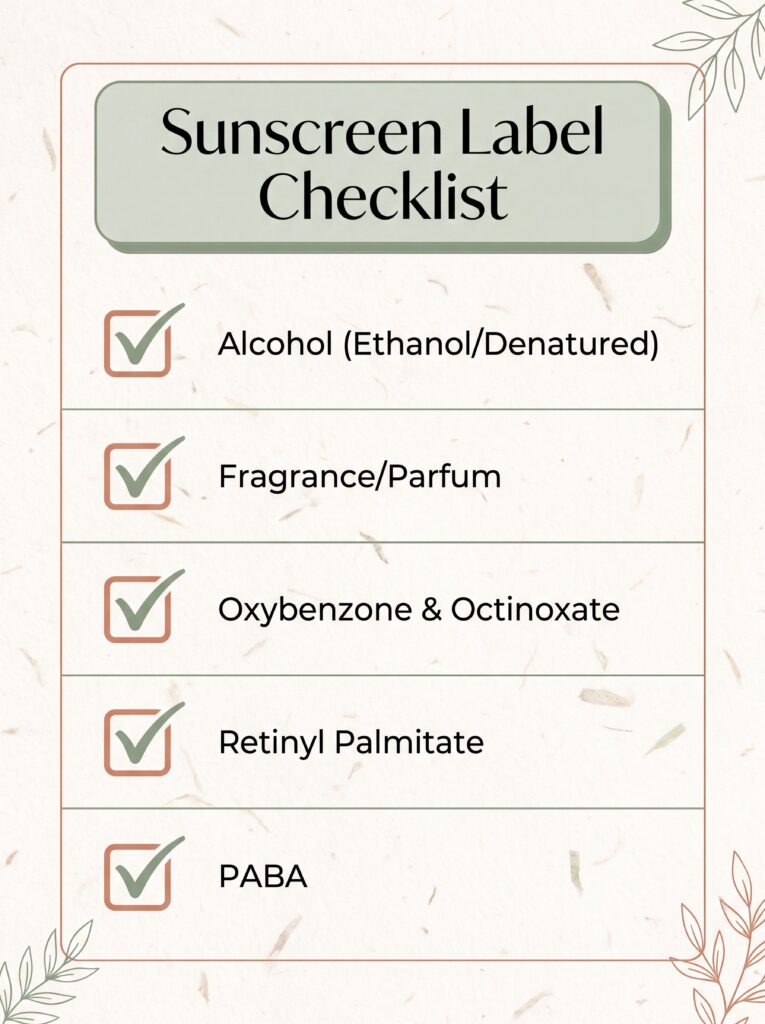
| Ingredient/Feature | Why It’s a Concern for Sensitive Skin |
|---|---|
| Fragrance / Parfum | Leading cause of allergic contact dermatitis in skincare |
| Oxybenzone | Frequently linked to stinging and allergic reactions |
| Alcohol Denat. (high up the list) | Can worsen dryness and barrier disruption |
| Chemical sunscreen sprays | Alcohol content and inhalation risk on the face |
| Essential oils | “Natural” fragrance still triggers reactions |
How to Choose the Right Sunscreen: A Step-by-Step Guide
- Identify your skin’s specific sensitivity. Eczema-prone skin needs extra ceramides and ultra-fragrance-free formulas. Rosacea-prone skin often does best with mineral formulas that reduce redness. Acne-prone-but-sensitive skin needs “non-comedogenic” on the label.
- Choose SPF 30 minimum, SPF 50 if you’re outdoors often. Broad-spectrum protection (UVA + UVB) is non-negotiable regardless of sensitivity.
- Pick mineral first if you’re new to this. Zinc oxide as the primary or sole active ingredient.
- Scan for fragrance and alcohol. Even “unscented” isn’t the same as “fragrance-free” — unscented can still contain masking fragrance.
- Patch test for 48 hours on your inner arm before full-face use.
- Reintroduce chemical filters slowly, if desired, once you know mineral works and you want a lighter-feeling option for daily wear.
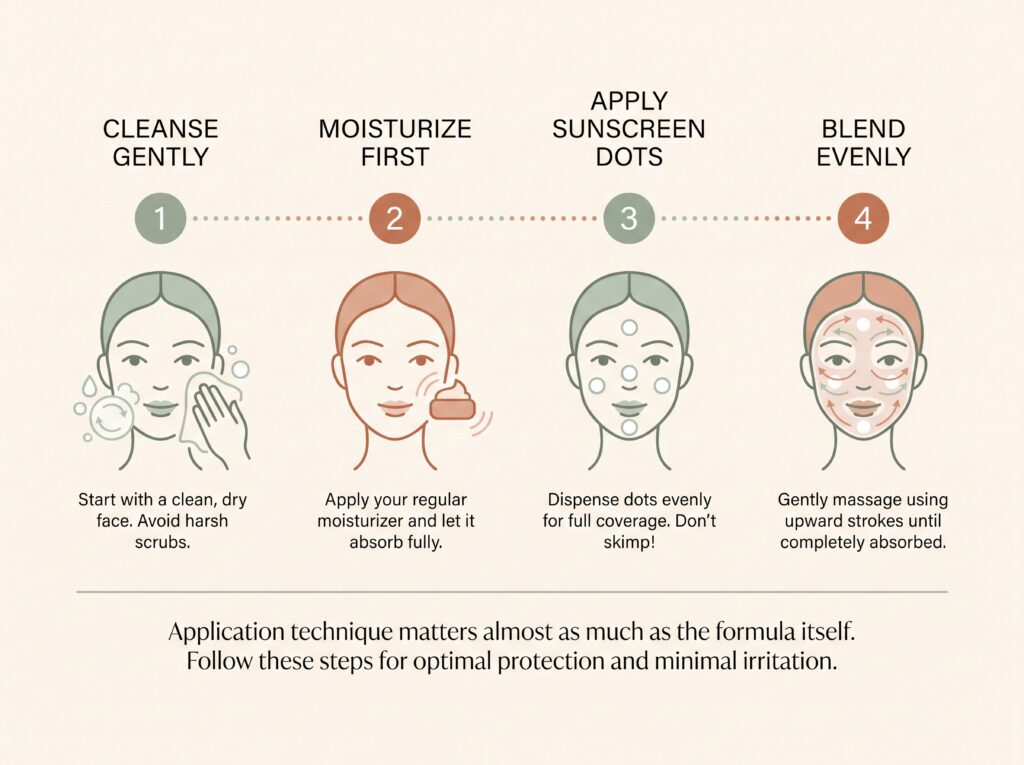
Pro Tip: Apply sunscreen as the last step of your morning routine, after moisturizer, and give it a few minutes to set before applying makeup — this reduces pilling, which is often mistaken for irritation.
Best Sunscreens for Sensitive Skin, by Category
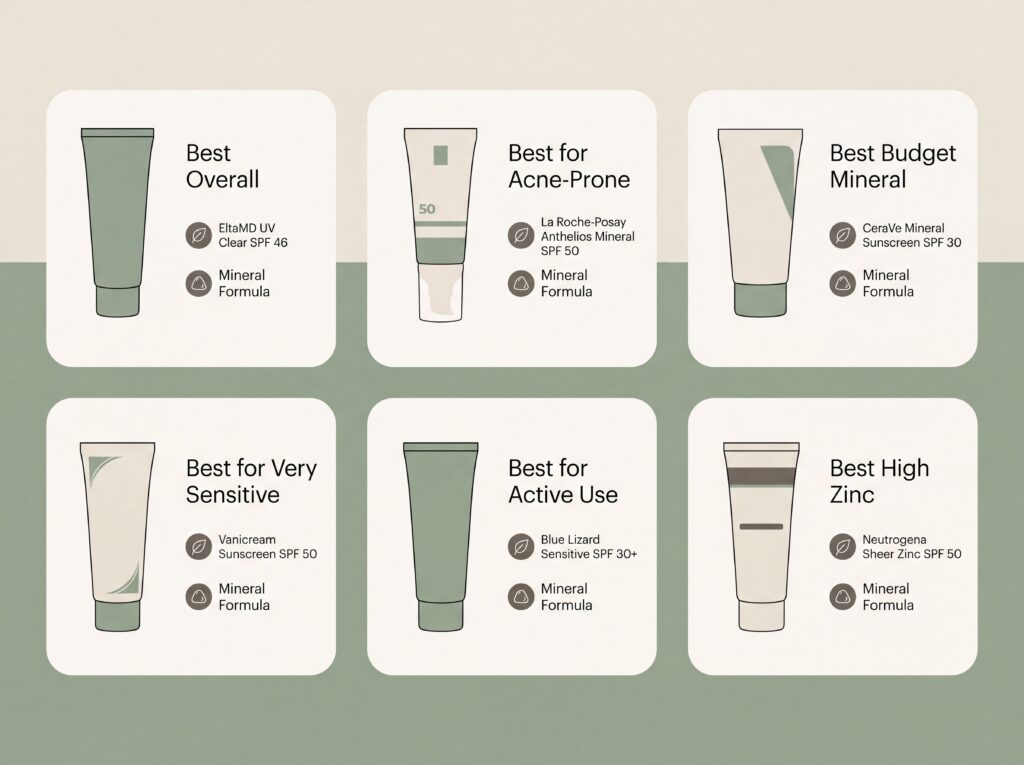
These are well-established, widely available formulas frequently recommended by dermatologists for reactive skin. Ratings below reflect editorial assessment based on formulation and reputation, not an aggregated review score.
| Product | Best For | Skin Type | Key Ingredients | Fragrance-Free | Price Range | Editorial Rating |
|---|---|---|---|---|---|---|
| EltaMD UV Clear SPF 46 | Best Overall | Sensitive, acne-prone, rosacea-prone | Zinc oxide, niacinamide | Yes | $45 | ⭐⭐⭐⭐⭐ |
| La Roche-Posay Anthelios Mineral SPF 50 | Best for Rosacea | Very sensitive, redness-prone | Zinc oxide, titanium dioxide | Yes | $25.99 | ⭐⭐⭐⭐⭐ |
| CeraVe Mineral Sunscreen SPF 30 | Best Budget Pick | Dry, eczema-prone | Zinc oxide, titanium dioxide, ceramides | Yes | $15.99 | ⭐⭐⭐⭐ |
| Vanicream Sunscreen SPF 50 | Best for Eczema | Extremely reactive/eczema-prone | Zinc oxide | Yes | $13.99 | ⭐⭐⭐⭐⭐ |
| Blue Lizard Sensitive SPF 30+ | Best for Kids & Sensitive Adults | Very sensitive, family use | Zinc oxide, titanium dioxide | Yes | $15.99 | ⭐⭐⭐⭐ |
| Neutrogena Sheer Zinc SPF 50 | Best Drugstore Mineral | Combination, sensitive | Zinc oxide | Yes | $16.49 | ⭐⭐⭐⭐ |
Pros and Cons: Mineral vs. Chemical Sunscreen
Mineral Sunscreen
- ✅ Lower reaction risk, gentle on compromised barriers
- ✅ Works immediately on application
- ✅ Naturally broad-spectrum
- ❌ Can leave a temporary white or gray cast, especially on deeper skin tones
- ❌ Slightly thicker texture
Chemical Sunscreen
- ✅ Lighter, more cosmetically elegant finish
- ✅ No white cast
- ❌ Higher chance of stinging or allergic reaction
- ❌ Needs 15–20 minutes to become effective after application
Common Myths & Facts
Myth: “Natural” sunscreens can’t cause reactions. Fact: Zinc oxide and titanium dioxide are the gentlest options, but “natural” marketing claims aren’t regulated — always check the actual ingredient list.
Myth: Higher SPF means more irritation. Fact: SPF number reflects UVB filtering strength, not formula gentleness. An SPF 50 mineral sunscreen can be just as gentle as an SPF 30 version.
Myth: If it doesn’t sting, it’s not working. Fact: A well-formulated sunscreen for sensitive skin should feel comfortable from the first application. Stinging is a sign to switch products, not a sign of efficacy.
Frequently Asked Questions
Is mineral sunscreen really better for sensitive skin? For most people with reactive, eczema-prone, or rosacea-prone skin, yes — mineral formulas with zinc oxide cause fewer reactions because they don’t require skin absorption to work.
Can sunscreen cause a rash even if I’ve used it before? Yes. Reactions can develop over time with repeated exposure to a specific ingredient, which is why switching to a fragrance-free mineral formula sometimes resolves a reaction that seemed to “appear out of nowhere.”
What SPF should sensitive skin use? SPF 30 is the minimum for daily protection; SPF 50 is reasonable for extended outdoor time. The SPF number doesn’t affect how gentle the formula is.
Is it okay to use sunscreen around the eyes if I have sensitive skin? Mineral formulas are generally the safer choice for the eye area, since chemical filters are more likely to cause stinging if sunscreen migrates into the eyes with sweat.
Do I still need sunscreen on cloudy days? Yes — up to 80% of UV rays pass through cloud cover, and UVA rays (which cause premature aging) are present year-round regardless of sun visibility.
Key Takeaways
- Sensitive skin reactions to sunscreen usually come from chemical filters, fragrance, or an already-compromised barrier — not sunscreen in general
- Mineral sunscreens with zinc oxide are the safest starting point for reactive, eczema-prone, or rosacea-prone skin
- Fragrance-free is not the same as unscented — always check the ingredient list
- SPF number doesn’t correlate with how gentle a formula is
- Patch testing for 48 hours prevents most full-face surprises
- Application technique (layering time, amount used) affects comfort as much as formula choice
- Broad-spectrum SPF 30+ is needed daily, rain or shine
Trust & Accuracy
- Last Updated: July 2026
- Fact-Checked: Yes
- Research-Based: Compiled using established dermatological consensus on sunscreen filters and sensitive-skin formulation
- Reviewed for Accuracy: Editorial review completed prior to publishing

Conclusion
Sensitive skin doesn’t mean you have to choose between sun protection and comfort. In most cases, switching to a fragrance-free, zinc-oxide-based mineral sunscreen resolves the stinging, redness, and breakouts that chemical formulas can trigger. From there, application habits — layering time, amount, and letting it set before makeup — do the rest. Start simple, patch test, and build from a formula you know your skin tolerates.
Recommended Next Reads
- How to Repair Your Skin Barrier: A Complete, Science-Backed Guide
- Why Is My Skin So Oily? The Real Reasons (And What Actually Helps)
- SkinSmart Hypochlorous Acid Facial Spray Review
- The Ordinary Glycolic Acid 7% Toner:Does It Really Work?
- Dry Skin? Here’s What Dermatologists Actually Recommend
Sources & References
- American Academy of Dermatology — Sunscreen FAQs
- Mayo Clinic — Sunburn and Sun Protection
- National Eczema Association — Sunscreen Recommendations for Eczema-Prone Skin
- Cleveland Clinic — Chemical vs. Physical Sunscreen
- U.S. Food & Drug Administration — Sunscreen: How to Help Protect Your Skin