If your skin has started stinging when you apply products that never used to bother you, or it feels tight and dry no matter how much moisturizer you layer on, you’re not imagining it. You’re likely dealing with a damaged skin barrier — and the good news is that it’s one of the most fixable skin problems out there, as long as you approach it the right way.
This guide walks through exactly what the skin barrier is, what damages it, and a realistic, step-by-step plan to repair it — without wasting money on products that make things worse.
Quick Summary Box
- Who this guide is for: Anyone with dry, reactive, stinging, or flaky skin caused by over-exfoliation, harsh products, or environmental stress.
- Best overall approach: Strip your routine down to a gentle cleanser, barrier-repair moisturizer, and SPF — nothing else — for 2–4 weeks.
- Budget recommendation: A basic ceramide-based moisturizer under $20 works as well as premium versions for barrier repair.
- Key takeaway: Less is more. Most barrier damage is caused by doing too much, not too little.
- Estimated reading time: 9 minutes
What Is the Skin Barrier, and Why Does It Matter?
Your skin barrier — sometimes called the stratum corneum — is the outermost layer of your skin. Think of it like a brick wall: skin cells are the bricks, and lipids (ceramides, cholesterol, and fatty acids) are the mortar holding everything together.
When that mortar is intact, your skin barrier does two jobs at once: it keeps water in, and it keeps irritants, allergens, and bacteria out. When the barrier is compromised, both of those jobs fail — water escapes too quickly (called transepidermal water loss), and outside irritants get in more easily, which is why damaged skin often feels dry and reactive at the same time.
Expert Tip: If a product that never bothered you before suddenly stings, that’s usually your first sign of barrier damage — not a sign you need a stronger product.
Common Causes of a Damaged Skin Barrier
Skin barrier damage rarely comes from one thing. It usually builds up from a combination of habits:
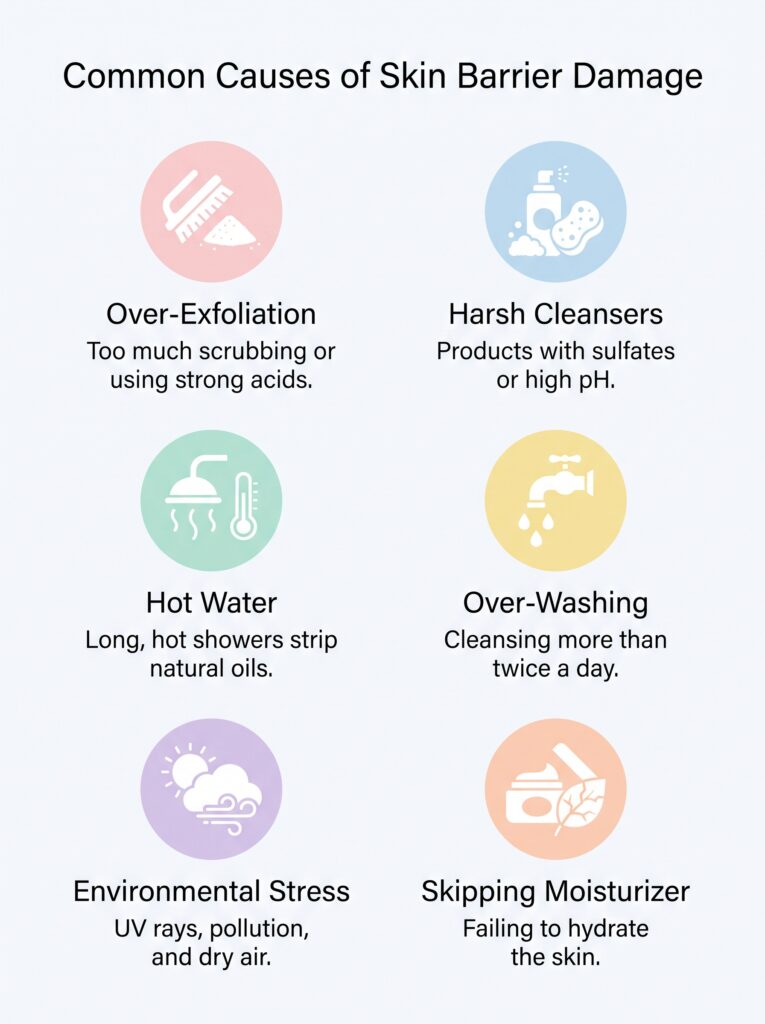
- Over-exfoliation — using acids (AHAs, BHAs) or retinoids too frequently or in combination
- Harsh cleansers — foaming or sulfate-heavy cleansers that strip natural oils
- Hot water — long, hot showers break down surface lipids
- Over-washing — cleansing more than twice a day
- Environmental stress — cold, dry air, wind, or excessive sun exposure
- Skipping moisturizer after active ingredients
- Combining too many actives at once (vitamin C, retinol, and acids layered together)
Symptoms of a Compromised Skin Barrier
- Persistent tightness, even after moisturizing
- Redness or a flushed appearance
- Stinging or burning with normal products
- Rough, flaky texture
- Small, itchy bumps
- Skin that looks dull or dehydrated despite oily patches
Myth vs. Fact
| Myth | Fact |
|---|---|
| “Oily skin can’t have barrier damage.” | Barrier damage can cause both dryness and excess oil as skin overcompensates. |
| “More moisturizer always helps.” | Over-moisturizing without addressing the cause can clog pores without fixing the barrier. |
| “Natural products are automatically gentler.” | Essential oils and fragrance (natural or synthetic) are common irritants for damaged skin. |
The Science: Why Barrier Repair Takes Time
Skin cells fully turn over roughly every 28–40 days (slower as we age), and lipid production needs time to rebuild. This is why dermatology sources generally note that visible improvement takes 2–4 weeks, with full barrier recovery often taking 4–6 weeks of consistent, gentle care.
There’s no shortcut here — the goal is to stop interfering with the skin’s natural repair process, not to force it faster with more products.
Step-by-Step Plan to Repair Your Skin Barrier
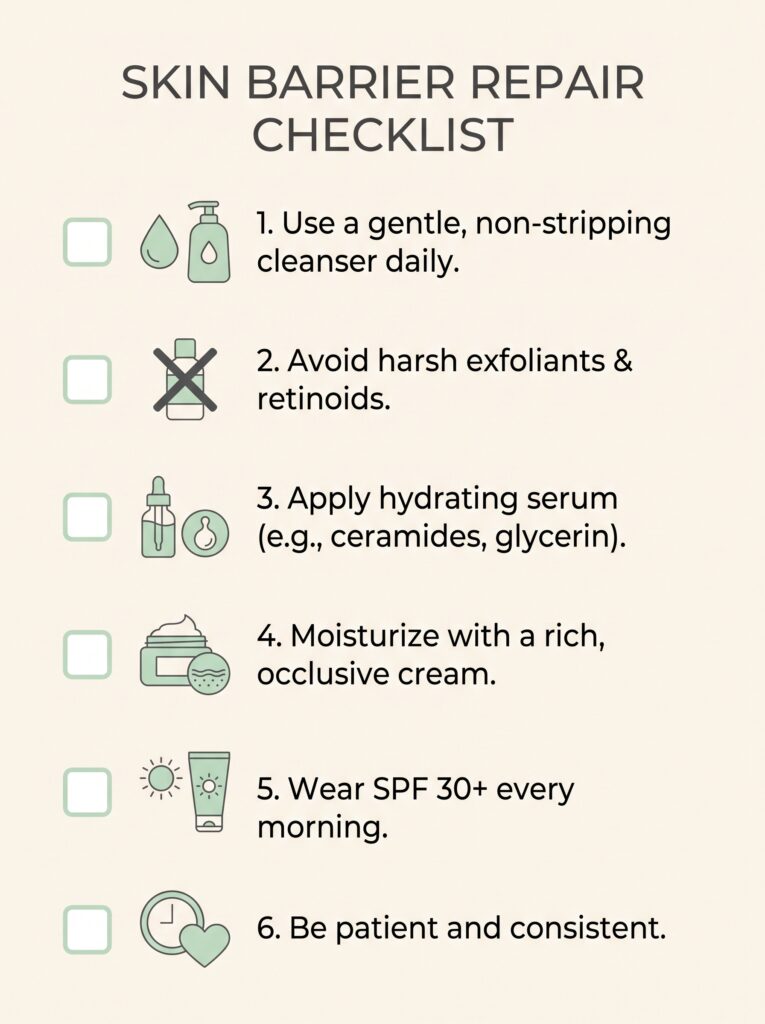
Step 1: Pause All Active Ingredients
Stop retinoids, AHAs/BHAs, vitamin C serums, and physical scrubs completely. This is temporary — usually 2–4 weeks — not permanent.
Step 2: Switch to a Gentle, Non-Foaming Cleanser
Look for cream or gel cleansers labeled “fragrance-free” and “non-foaming.” Avoid sulfates (SLS/SLES).
Step 3: Use Lukewarm Water Only
Hot water accelerates lipid breakdown. Lukewarm water is far gentler on compromised skin.
Step 4: Apply a Barrier-Repair Moisturizer
Look for ingredients that mimic your skin’s natural barrier composition:
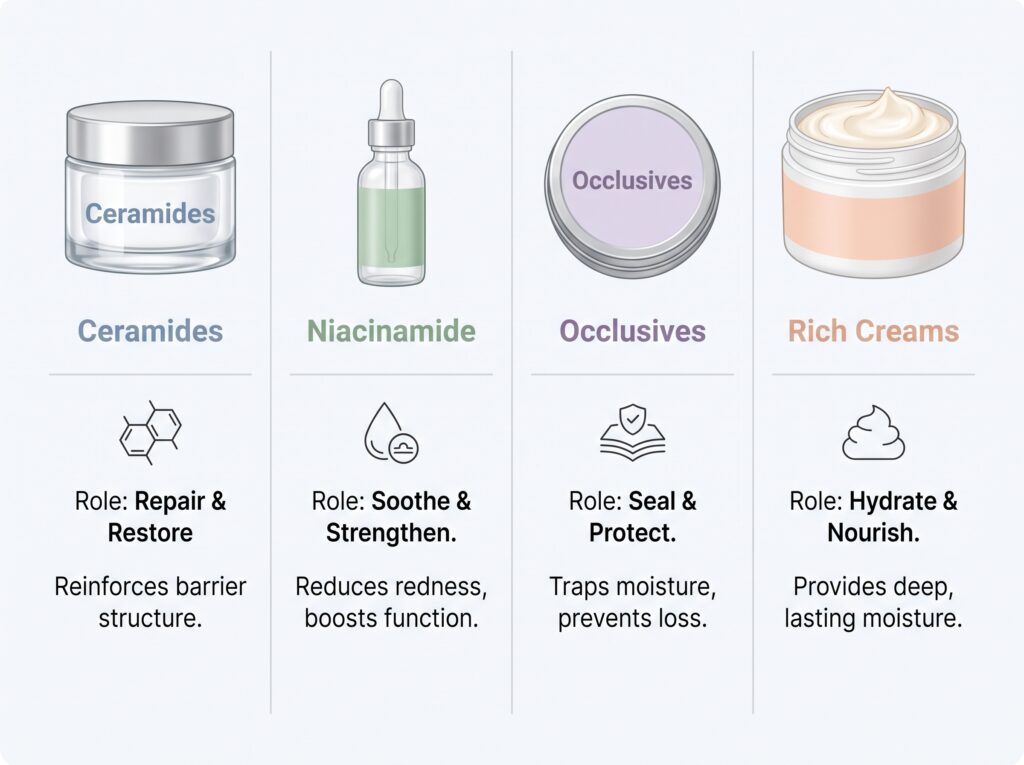
- Ceramides — rebuild the “mortar” between skin cells
- Cholesterol and fatty acids — support the same lipid matrix
- Niacinamide — reduces inflammation and supports barrier function
- Panthenol (Pro-Vitamin B5) — soothes and hydrates
- Hyaluronic acid — draws in water without irritating
Step 5: Don’t Skip Sunscreen
UV exposure slows healing and worsens inflammation. A mineral (zinc oxide) sunscreen is typically gentler on compromised skin than chemical filters.
Step 6: Simplify Everything Else
Cut your routine down to three steps: cleanse, moisturize, protect. Reintroduce actives slowly, one at a time, only after symptoms fully resolve.
Pro Tip: When reintroducing actives after recovery, start with one product, 2–3 times per week, and increase frequency slowly over several weeks.
Best Ingredients for Barrier Repair (Comparison Table)
| Product Type | Best For | Skin Type | Key Ingredients | Fragrance-Free | Price Range | Overall Rating |
|---|---|---|---|---|---|---|
| Ceramide Cream | Daily barrier repair | Dry, sensitive, compromised | Ceramides, cholesterol, fatty acids | Yes | $ (Budget) | ⭐⭐⭐⭐⭐ |
| Niacinamide Serum | Reducing inflammation | All types, especially reactive skin | Niacinamide, panthenol | Yes | $ | ⭐⭐⭐⭐ |
| Occlusive Balm | Overnight repair, severe dryness | Very dry, flaking skin | Petrolatum, squalane | Yes | $ | ⭐⭐⭐⭐⭐ |
| Rich Cream (Premium) | Long-term maintenance | Dry, mature, sensitive | Ceramides, peptides, shea butter | Yes | $$$ (Premium) | ⭐⭐⭐⭐⭐ |
Who should buy the budget ceramide cream: Anyone starting barrier repair for the first time — the core ingredients matter more than the price tag.
Who should consider the premium option: Those with chronic sensitivity or mature skin who want added peptides for long-term skin support.
Who should avoid heavier occlusive balms: People with acne-prone skin on the face, unless used only on isolated dry patches.
Beginner Mistakes to Avoid
- Introducing a new active ingredient before symptoms fully resolve
- Using multiple “repair” products at once (over-layering can also irritate)
- Switching products every few days instead of giving one routine time to work
- Over-cleansing in an attempt to “reset” skin faster
- Ignoring sunscreen because skin “feels fine” that day
Frequently Asked Questions
How long does it take to repair a skin barrier? Most people see improvement within 2–4 weeks, with full recovery often taking up to 6 weeks of consistent, gentle care.
Can you over-moisturize a damaged skin barrier? Yes — piling on too many heavy products can trap heat and clog pores without addressing the underlying cause. Focus on one well-formulated moisturizer rather than several.
Is skin barrier damage permanent? No, in most cases it’s fully reversible with consistent care and by removing the cause of the damage.
Can I still wear makeup while repairing my skin barrier? Yes, but choose fragrance-free, non-comedogenic products, and avoid long-wear formulas that require harsh removal.
When can I reintroduce retinol or acids? Only after symptoms (redness, stinging, flaking) have fully resolved — typically 3–6 weeks — and then reintroduce slowly.
Key Takeaways
- A damaged skin barrier causes both dryness and reactivity at the same time.
- Over-exfoliation and harsh cleansing are the most common causes.
- Recovery typically takes 2–6 weeks of consistent, gentle care.
- Simplify your routine to cleanser, moisturizer, and SPF during recovery.
- Ceramides, niacinamide, and panthenol are the most evidence-backed repair ingredients.
- Reintroduce actives slowly, one at a time, only after symptoms resolve.
- More products is not the same as better care — consistency matters most.
Trust & Accuracy
- Last Updated: July 2026
- Fact Checked: Yes
- Research Based: Yes, referencing established dermatology sources
- Reviewed for Accuracy: Yes
Who Should Read This Guide (and Who Shouldn’t)
This guide is for you if: you have dry, tight, stinging, or flaky skin that developed after starting new actives, over-cleansing, or seasonal changes.
This guide may not fully apply if: you have a diagnosed skin condition such as eczema, rosacea, or dermatitis — in these cases, work directly with a dermatologist, since your treatment plan may differ from general barrier-repair advice.
Conclusion
Repairing your skin barrier isn’t about finding one miracle product — it’s about removing whatever is causing the damage and giving your skin the time and simple support it needs to rebuild itself. Strip your routine down, be patient for a few weeks, and reintroduce actives slowly once your skin feels calm again. That simple discipline is what separates people who fix their skin barrier for good from people who cycle through the same problem every few months.
Sources & References
- American Academy of Dermatology (AAD) — aad.org
- National Eczema Association — nationaleczema.org
- Cleveland Clinic — clevelandclinic.org
- Mayo Clinic — mayoclinic.org
Recommended Next Reads
- CeraVe Daily Moisturizing Lotion Review
- Why Is My Skin So Oily? The Real Reasons (And What Actually Helps)
- Dry, Itchy Skin Around the Eyes: What Finally Worked for Me 5 Best products
- SkinSmart Hypochlorous Acid Facial Spray Review
- K18 Leave-In Molecular Repair Hair Mask Review
Additional Image Assets