

Dry skin is one of those problems that feels simple on the surface — just moisturize, right? But anyone who has actually dealt with it knows it is rarely that straightforward.
The wrong cleanser strips what little moisture you have. The wrong moisturizer sits on top and does nothing. And the tight, flaky, uncomfortable feeling keeps coming back no matter what you try.
We went through dermatologist recommendations, real user experiences, and the latest research to put together this no-fluff guide to actually fixing dry skin for good.
Why Your Skin Gets Dry in the First Place
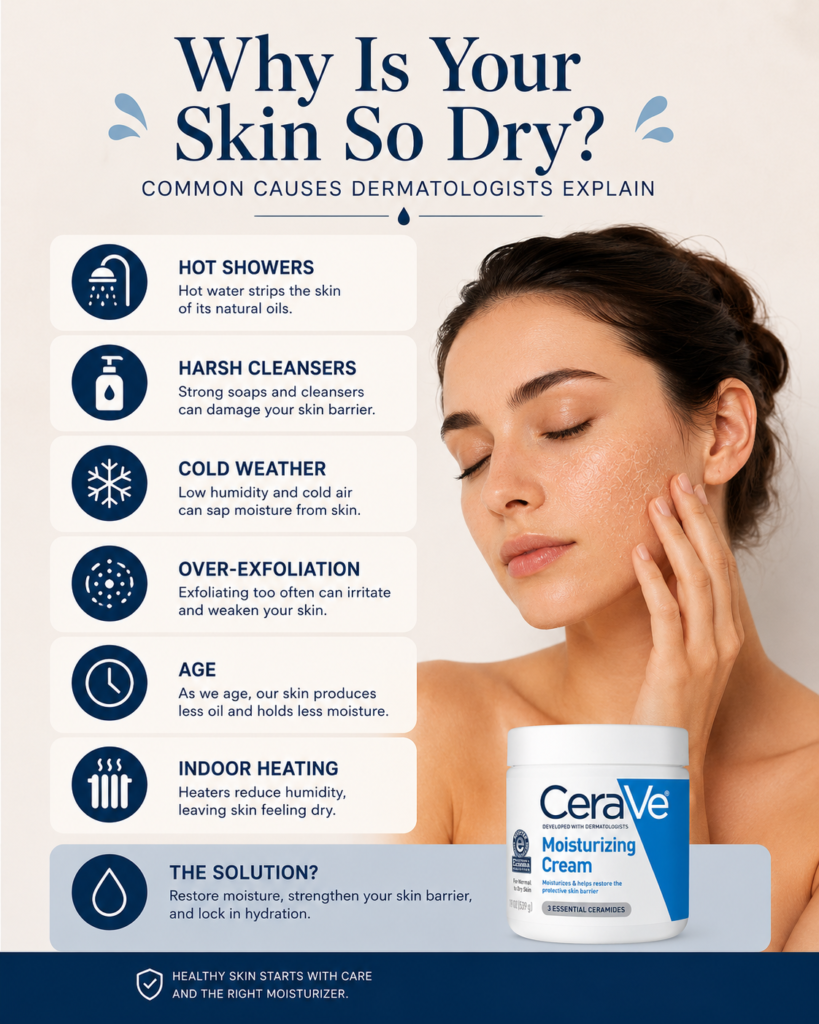
Dry skin is not just about lacking moisture. It is about a compromised skin barrier the outermost layer of your skin that is supposed to hold water in and keep irritants out.
When this barrier is weakened, moisture evaporates faster than the skin can replace it. The result is skin that feels tight, looks flaky, and reacts to almost everything.
The most common causes:
- Hot showers – hot water strips natural oils from the skin surface
- Harsh cleansers — soaps with sulfates remove the barrier lipids your skin needs
- Cold weather and low humidity — the environment pulls moisture from skin
- Over-exfoliation — removes protective layers faster than skin can rebuild
- Age — lipid production naturally slows over time, making dryness more common
- Central heating — indoor heating significantly lowers air humidity
Understanding the cause matters because it changes how you fix it.
The Right Way to Build a Dry Skin Routine
The order matters just as much as the products.
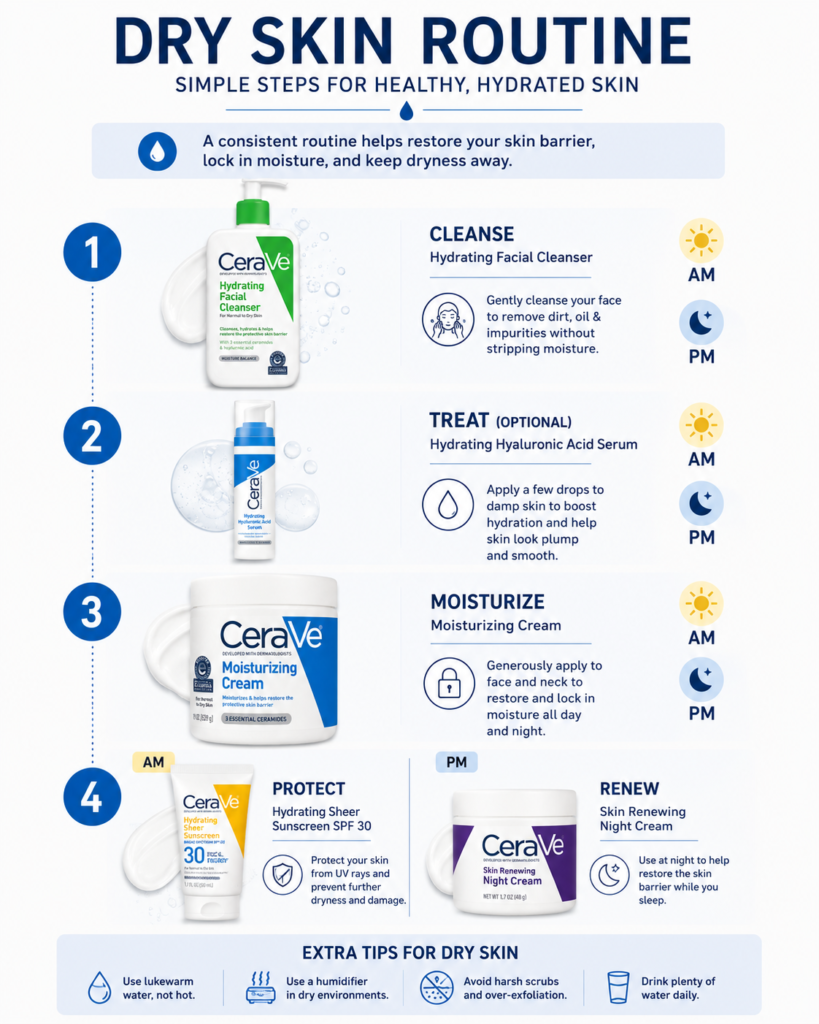
Step 1: Cleanser
This is where most people go wrong. A cleanser that lathers heavily is almost always stripping your skin.
What to look for: Fragrance-free, sulfate-free, with ceramides or glycerin. What to avoid: Anything with sodium lauryl sulfate (SLS), alcohol, or strong fragrance.
Keep showers short 5 to 10 minutes — and use lukewarm water, not hot. Apply cleanser only where you actually need it.
Dermatologist picks:
Step 2: Moisturizer (The Most Important Step)
Apply immediately after cleansing — within two minutes of patting your skin damp-dry. This is the window when your skin absorbs moisture most effectively.
For dry skin, you need a cream — not a lotion, not a gel. Creams are richer and create a stronger barrier.
The best ingredients for dry skin:
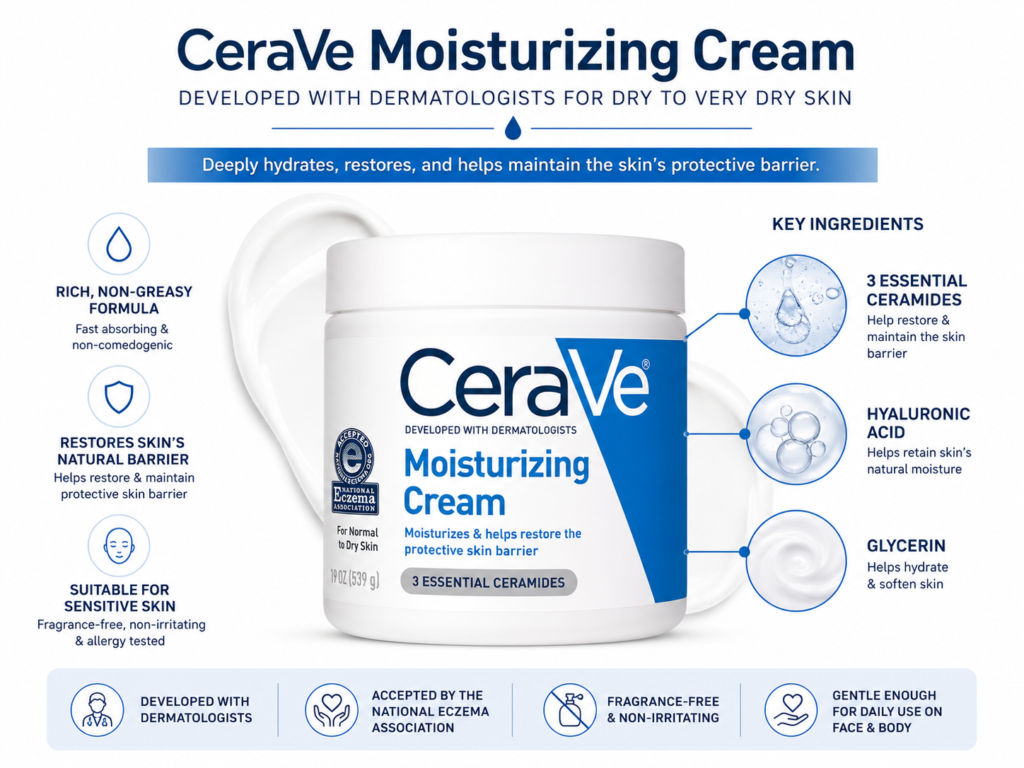
Ceramides — repair the skin barrier from within. Ceramides make up 50% of the skin’s natural barrier lipids. When they are depleted, dryness follows. Replenishing them is not optional — it is the fix.
Hyaluronic Acid — pulls moisture into the skin from the environment. Works best on damp skin.
Glycerin — a humectant that keeps water in the skin throughout the day.
Petrolatum — seals the surface and prevents moisture from evaporating. Despite its reputation, it is non-comedogenic and one of the most effective occlusive ingredients available.
The product most dermatologists actually recommend:
CeraVe Moisturizing Cream checks every box — three essential ceramides, hyaluronic acid, glycerin, and MVE technology that releases hydration slowly over 24 hours. It is fragrance-free, non-comedogenic, and holds the National Eczema Association Seal of Acceptance.
At under $20, it is one of the strongest value propositions in skincare. Board-certified dermatologists across the US recommend it — not because it is sponsored, but because the formula genuinely works.
Step 3: Serum (Optional but Helpful)
If your dryness is persistent, a hyaluronic acid serum applied before your moisturizer adds an extra layer of hydration.
Apply to slightly damp skin. Follow immediately with your cream — hyaluronic acid needs to be sealed in or it can actually pull moisture from the skin in low-humidity environments.
The Ordinary Hyaluronic Acid 2%
Step 4: SPF (Morning Only)
Dry skin and UV damage are a bad combination. Sun exposure degrades the skin barrier further and worsens dryness over time.
Choose a moisturizing sunscreen — one that combines SPF with ceramides or hyaluronic acid so it works as both protection and hydration.
Step 5: Night Cream or Occlusive (Evening)
Nighttime is when skin repairs itself. A slightly richer product at night — or the technique called slugging (applying a thin layer of Vaseline or Aquaphor as the very last step) — seals in everything you applied and gives the skin the ideal environment to regenerate.
5 Habits That Make Dry Skin Worse
Even the right products will not work if these habits undo everything.
1. Hot showers daily. Switch to lukewarm. Even five degrees cooler makes a significant difference to how much natural oil is stripped.
2. Rubbing skin dry with a towel. Pat — do not rub. Rubbing creates friction that disrupts the barrier.
3. Waiting too long to moisturize after showering. The two-minute window after cleansing is critical. After that, moisture evaporation starts and the benefit of moisturizer reduces.
4. Using fragranced products. Fragrance is the most common contact irritant in skincare. For already-compromised dry skin, it consistently makes things worse.
5. Over-exfoliating. Exfoliation has a place in a dry skin routine — but once a week maximum. More than that removes the protective layers the skin is trying to rebuild.
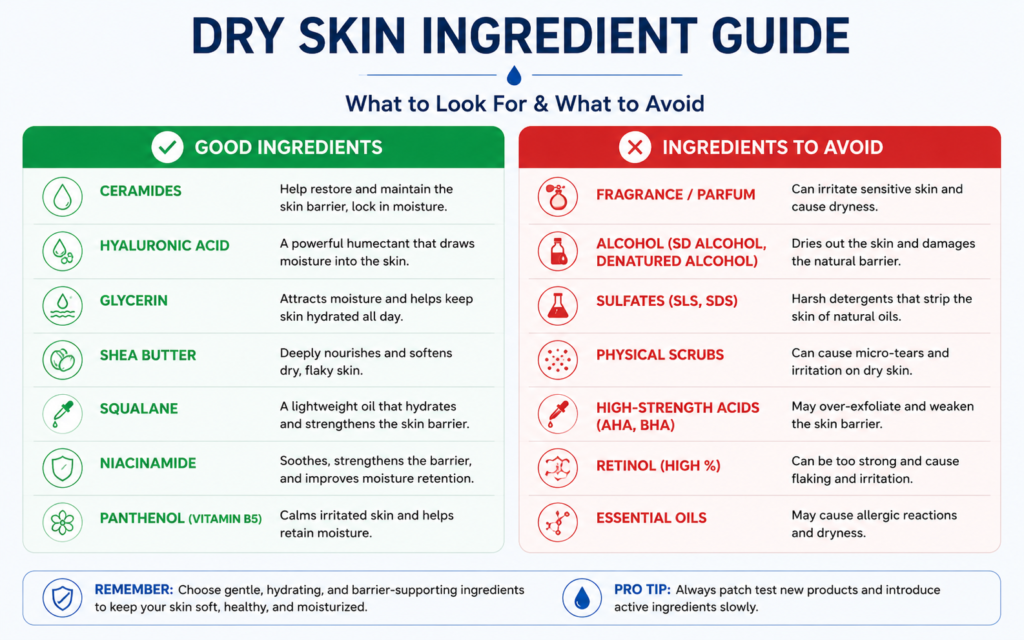
Ingredients to Look For vs. Ingredients to Avoid
| Look For | Avoid |
|---|---|
| Ceramides | Sodium Lauryl Sulfate (SLS) |
| Hyaluronic Acid | Alcohol (denat.) |
| Glycerin | Fragrance / Parfum |
| Petrolatum / Shea Butter | Benzoyl Peroxide (drying) |
| Squalane | Strong exfoliating acids daily |
| Niacinamide | Heavily foaming cleansers |
When to See a Dermatologist
Most dry skin responds to the right routine within two to four weeks. But some cases need professional attention.
See a dermatologist if:
- Dryness is severe and does not respond to over-the-counter products
- You have itching that disrupts sleep
- Skin is cracking and bleeding
- You suspect eczema, psoriasis, or another underlying condition
These conditions require prescription treatment — no amount of ceramide cream will fully address active eczema without medical management alongside it.
The Bottom Line
Fixing dry skin is not about finding the most expensive product. It is about understanding what your barrier needs — ceramides, humectants, and occlusives — and stopping the habits that keep destroying what you rebuild.
The routine does not need to be complicated. A gentle cleanser, a ceramide-rich cream like CeraVe Moisturizing Cream, and consistent SPF in the morning covers most of what dry skin needs.
Give it four weeks of consistency before judging whether it is working. Skin barrier repair is gradual — but it is also reliable when you give it the right tools.