
My friend Sarah bleached her hair three times in two months.
I know. I know.
By the end of it, her hair was not hair anymore. It was something closer to dry straw that snapped when she touched it. She was finding broken pieces on her pillow, in her sink, everywhere. Her ponytail had gone from thick to barely there. She was genuinely considering cutting it all off and starting over.
Then her hairstylist mentioned K18.
“It works on a molecular level,” the stylist said. “Most people see results in one use.”
Sarah bought the small tube – $29 for 0.5 oz – came home, followed the instructions exactly, and texted me two hours later with one word:
WHAT.
That is how most K18 stories begin. And that is exactly why I decided to dig deep into what this product actually does, who it actually works for, and why some people get zero results while others describe it as the most transformative haircare product they have ever tried.
Here is everything I found.
What Is K18 Leave-In Molecular Repair Hair Mask?
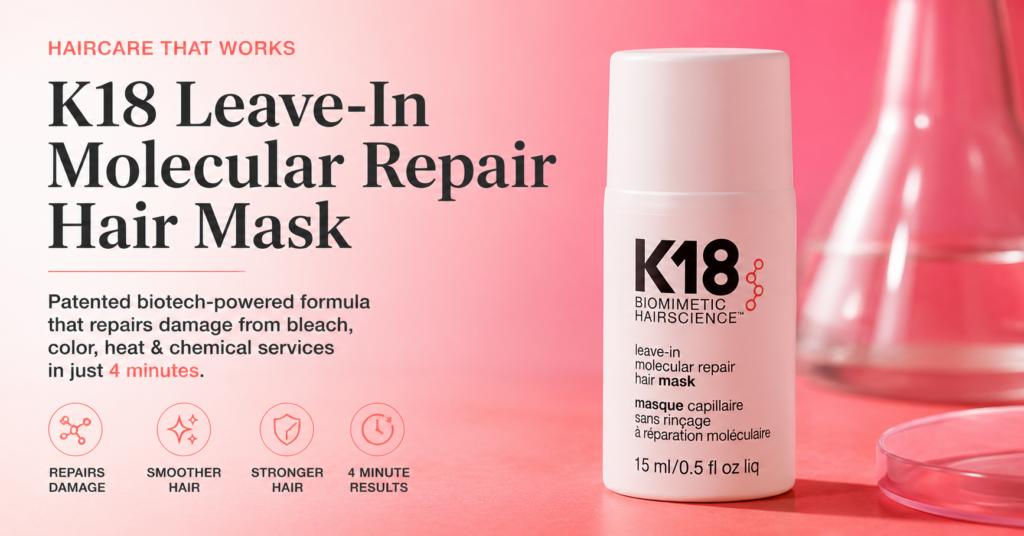
K18 is a leave-in hair treatment – not a rinse-out mask, despite the name. You apply it after shampooing on towel-dry hair, wait four minutes, and then style as normal. No rinsing. No heat needed. No conditioner before it.
The brand was founded in 2020 and quickly became one of the most talked-about haircare launches in years. It was named one of TIME Magazine’s best inventions of 2021. It is now available in Sephora, Amazon, and professional salons worldwide.
It comes in three sizes. The mini (0.17 oz) is around $12 to $14. The small tube (0.5 oz) is around $29. The full size (1.7 oz) is around $75. And yes – that price creates a lot of opinions.
The core claim is bold: K18 can reverse hair damage from bleach, color, chemical services, and heat — at the molecular level – in just four minutes.
That sounds like marketing language. So let us look at whether the science actually backs it up.
The Science – What ‘Molecular Repair’ Actually Means
This is where K18 genuinely stands apart from most haircare products, and it is worth understanding properly because it explains both why it works so well for some people and why it does not work for others.
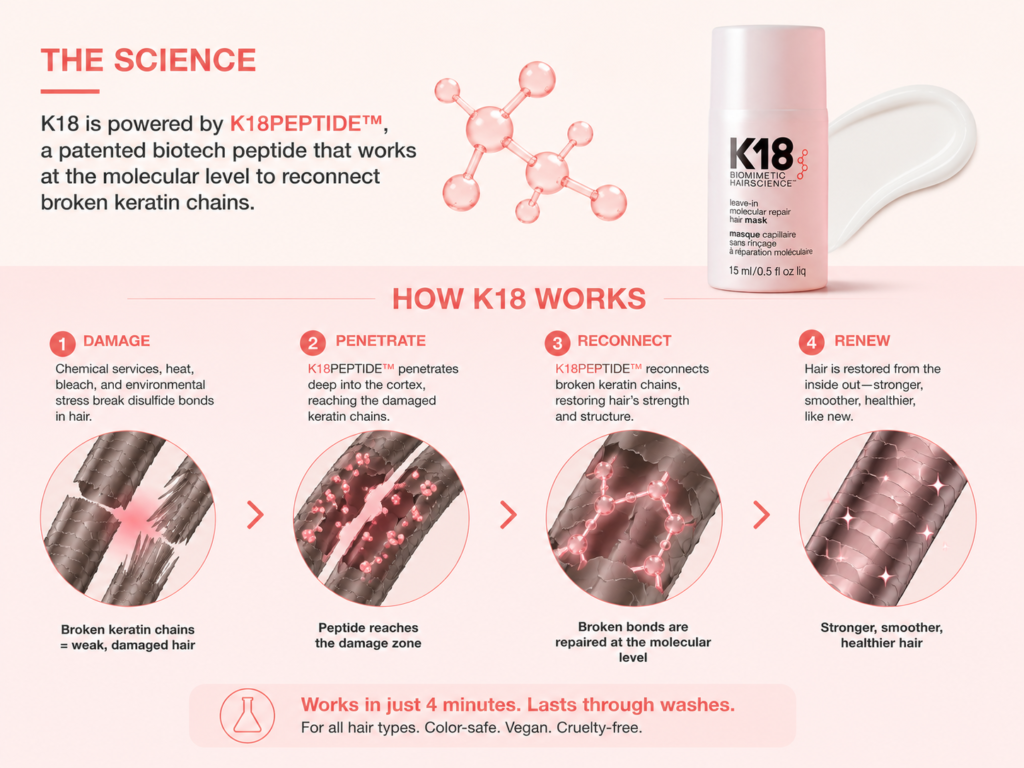
Hair is made of keratin – a protein. Keratin is structured through two types of bonds that give hair its strength, elasticity, and structure:
Polypeptide chains – the long chains of amino acids that form the backbone of the hair fiber. Think of them as the main structure of a rope.
Disulfide bonds – the cross-links between polypeptide chains that hold the rope together and give it strength. These are what are broken during bleaching, perming, relaxing, and heat damage.
When these bonds break, hair loses its strength, elasticity, and structure. It becomes brittle, frizzy, prone to breakage, and unable to hold its natural curl pattern. Traditional conditioners and masks coat the outside of the hair shaft – they make it feel softer temporarily but do not repair the internal damage.
K18 takes a different approach entirely.
The brand’s patented ingredient – K18Peptide – is a bioactive peptide that was developed using biotech research. It is specifically designed to mimic the structure of the hair’s natural polypeptide chains. When applied to damaged hair, the K18Peptide penetrates into the innermost layer of the hair shaft, finds the broken polypeptide chains, and reconnects them. As a side effect of this reconnection, disulfide bonds are also reformed reinforcing strength along the entire length and width of the hair strand.
This is not surface-level smoothing. It is internal structural repair.
And unlike many haircare claims, this one is backed by clinical testing. In independent studies, K18 treatment resulted in measurable improvements in hair strength, elasticity, and resistance to further damage compared to untreated hair.
The Ingredients Minimal by Design
K18 is notable for having an extremely short ingredient list. The brand is intentional about this — they use only what is necessary to get the peptide where it needs to go.
K18Peptide |Lauroyl Tetrapeptide-30|
The hero ingredient. A biotech-developed tetrapeptide – meaning it is made of four amino acids – that is specifically engineered to match the structure of hair’s natural polypeptide chains. This is not a generic peptide; it is a patented molecule designed specifically for hair repair at the structural level.
Alcohol Blend |Three Types|
This is the most frequently misunderstood part of the formula, and it generates a lot of concern from people who associate alcohol with drying. K18 uses a specific blend of three alcohols – not to dry hair out, but to temporarily open the hair cuticle. This is necessary because the K18Peptide needs to penetrate into the innermost cortex of the hair shaft. The cuticle normally acts as a barrier. The alcohol blend creates a temporary opening for the peptide to enter and do its work. Once the four-minute treatment window passes and the product dries down, the cuticle closes again – and the peptide is locked inside.
Citric Acid
Used to adjust the pH of the formula to ensure the cuticle opens appropriately for penetration and that the product works at optimal effectiveness.
Water |Aqua|
The base of the formula.
That is the complete ingredient list. Five ingredients. Each one with a specific, documented purpose.
How to Use K18 – The Exact Method That Determines Your Results
This is critical. K18’s instructions are specific, and the most common reason people see poor results is incorrect application. Here is the exact method:
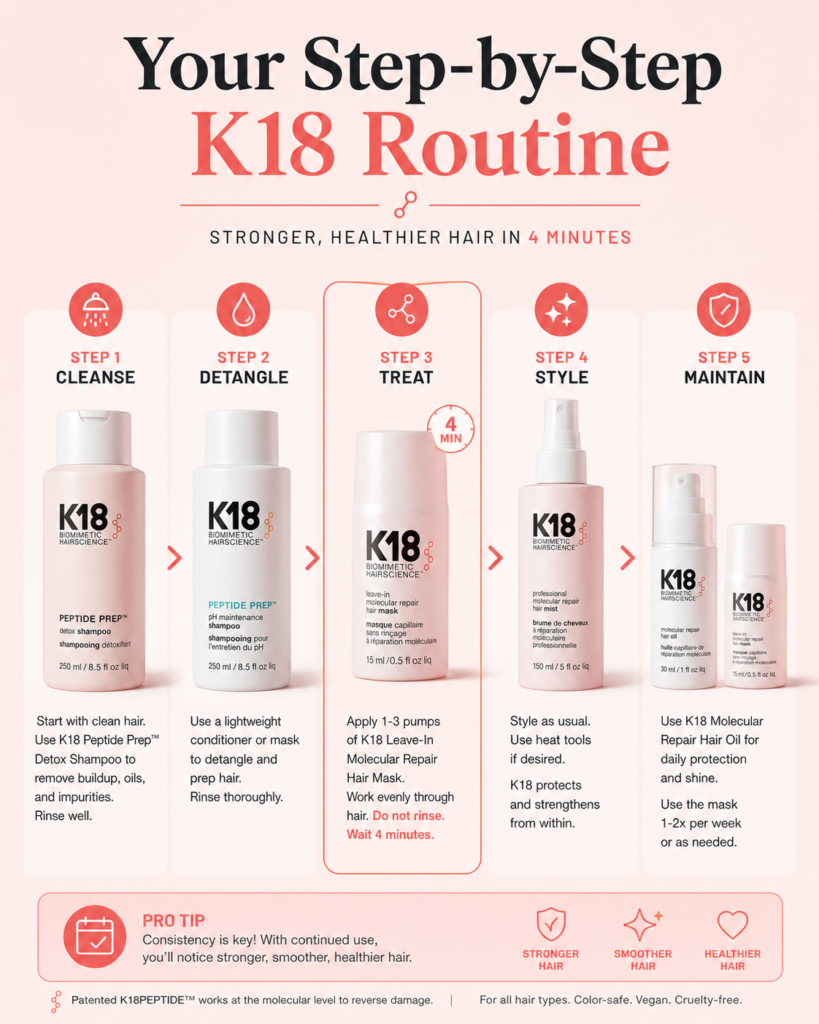
Step 1 = Shampoo your hair Use a clarifying or regular shampoo. If you have product buildup, use a clarifying shampoo first — buildup prevents the peptide from penetrating.
Step 2 = Skip the conditioner Do not use conditioner before K18. Conditioner coats the hair shaft, which prevents the peptide from penetrating. This is the instruction that feels most counterintuitive, but it is non-negotiable for the product to work.
Step 3 = Towel dry to damp Hair should be damp, not dripping wet. Squeeze out excess water gently.
Step 4 = Apply K18 Start with one pump (about 0.5 to 1 ml). For most hair lengths and densities, one to three pumps is sufficient. Do not over-apply — more product does not mean better results. Work it through from mid-lengths to ends first, then roots last.
Step 5 = Wait exactly four minutes This is the treatment window. The peptide actively reconnects broken bonds during this time. Set a timer. Do not rinse.
Step 6 = Style as normal Apply any leave-in conditioner, styling products, or heat protectant on top after the four minutes. Blow dry, air dry — whatever your normal method is.
For damaged hair – the loading phase: K18 recommends using the treatment for six consecutive washes when first starting, to fully address existing damage. After that, once every four to six washes for maintenance.
What Real Customers Are Saying – The Complete Picture
We went through hundreds of reviews across Amazon, Sephora, Reddit, TikTok, and beauty publications to give you an accurate, unfiltered picture.
The People Who Love It
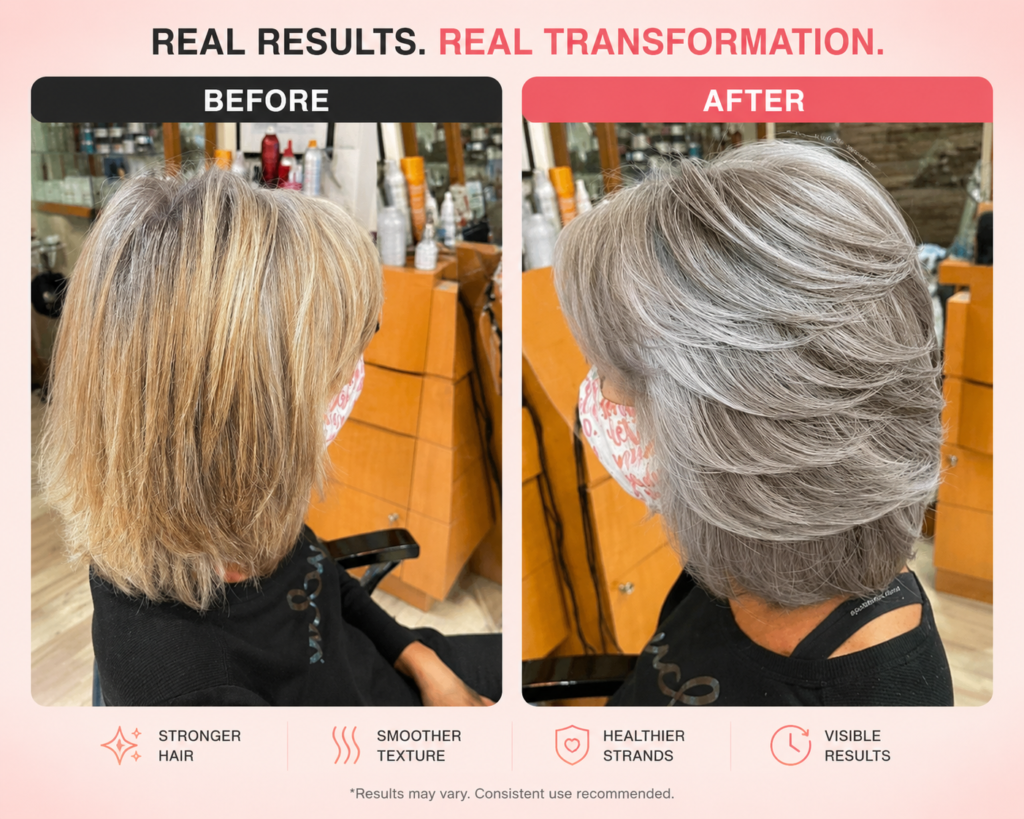
A beauty writer with over a decade of experience in the industry described her hair as straw-like after a COVID-era coloring spree. After one K18 treatment, her damaged strands felt silkier and looked shinier. She has been using it consistently for over two years since.
A curly-haired user who was skeptical about the four-minute claim described noticeable curl definition and smoothness after the very first use – and described it as one of the best products she had ever found to quickly restore damaged curls.
Someone whose hair was actively breaking off after bleaching – coming out in handfuls – described K18 stopping the breakage after a few treatments. Her hair went from snapping and looking like straw to behaving like normal hair again.
One user who incorporated it after a trichologist’s recommendation described their hair feeling thicker and significantly stronger after using it for the first six consecutive washes, then moving to weekly maintenance.
Multiple hairstylists recommend it to clients specifically after bleaching, highlighting, or chemical services – it has become a standard post-service product in many professional salons.
Clinically, K18’s own studies show that after a single treatment, hair strength improves by up to 91% compared to untreated bleached hair, and elasticity improves by up to 94%. These are significant numbers, and independent beauty publications have consistently found the results match the clinical data for the right hair types.
The People Who Are Disappointed
Here is the honest part – because the negative reviews are real and they follow a consistent pattern.
One reviewer with very curly, low-porosity hair described an experience that went against everything K18 promises. She skipped conditioner as instructed and her hair became matted, brittle, and impossible to detangle. After three days, her hair still had not softened and she had to wash again with conditioner to restore it to normal. She noticed no improvement from K18 at all.
A writer who tested K18 for three months described seeing slightly less shedding but no dramatic improvement – not nearly enough to justify the price for her hair type. Her verdict: the product works for severely chemically damaged hair, but if your damage is moderate or your hair is thick and curly with high moisture needs, the results may not be worth $75.
Multiple people with thick, coily, or Afro-textured hair report that while K18 claims to work on all hair types, the no-conditioner instruction is a significant problem. Hair that relies heavily on conditioner for detangling and moisture retention often reacts poorly to the K18 method, and the repair benefits do not always outweigh the dryness and tangles that come with skipping conditioner.
Some users report that the product works well initially but then loses its effectiveness with repeated use – hair returns to its previous state faster than expected between treatments.
The small bottle size generates consistent frustration. The 0.5 oz tube is marketed as a one-month supply for most people, but those with longer, thicker, or highly damaged hair find it lasts only two to three weeks.
And one particularly honest reviewer put it plainly: if your damage is severe enough that the hair needs cutting, K18 will not save it. It repairs broken bonds, but it cannot rebuild hair that has been too far degraded.
K18 vs. Olaplex No. 3 – The Comparison Everyone Asks About
K18 and Olaplex are the two most talked-about bond repair treatments available, and the comparison is worth addressing directly.
How they work: Olaplex No. 3 works primarily by reconnecting disulfide bonds the cross-links between polypeptide chains. K18 works by reconnecting the polypeptide chains themselves, which as a secondary effect also reforms disulfide bonds. K18 targets the internal structure at a deeper level.
Application: Olaplex No. 3 is a pre-shampoo rinse-out treatment apply, wait 10 to 30 minutes, shampoo out, condition as normal. K18 is a leave-in apply after shampooing, wait four minutes, style over it.
Results for chemically damaged hair: Many users who have tried both describe K18 as producing faster and more dramatic results for severe chemical damage, particularly after bleaching. Olaplex is better suited for ongoing maintenance and prevention.
Price: Olaplex No. 3 is around $28 for 3.3 oz. K18 full size is $75 for 1.7 oz. K18 is significantly more expensive per ounce.
Who should choose which: If you have severely bleached or chemically damaged hair and want the fastest repair K18. If you want an ongoing weekly treatment to maintain healthy hair and prevent damage Olaplex No. 3. Many people who are serious about their hair use both, alternating them in their routine.
Who Should Use K18 And Who Should Probably Skip It
Strong fit:
- Hair that has been bleached, colored, highlighted, or chemically processed
- Heat-damaged hair from excessive flat iron or blow dryer use
- Hair that has lost elasticity and snaps rather than stretching when pulled
- Swimmers whose hair is damaged from chlorine exposure
- People currently going through a color correction process
- Anyone whose hairstylist has recommended bond repair treatment
- Hair that has been permed or relaxed
Not an ideal fit:
- Healthy, undamaged hair the repair effect requires damage to work on. Using K18 on healthy hair produces minimal results since there are no broken bonds to reconnect.
- Very thick, coily, or Afro-textured hair with high moisture needs the no-conditioner instruction can cause more problems than the repair benefits solve
- Fine hair that tends toward buildup K18 can cause heaviness or clumping if overused
- Anyone looking for a hydrating conditioner K18 is a repair treatment, not a moisturizing product
- People with a very tight budget at $75 for the full size, the cost-benefit only makes sense for genuinely damaged hair
Common Mistakes That Ruin Your Results
Mistake 1: Using conditioner before K18 This is the single most common error. Conditioner coats the hair shaft and prevents the K18Peptide from penetrating. The no-conditioner instruction is non-negotiable. You can use conditioner over K18 after it has processed.
Mistake 2: Applying too much product More is not better. Overusing K18 leads to buildup, heaviness, and clumping. One pump is the starting point. Add a second pump only if your hair is very long or very thick.
Mistake 3: Not doing the loading phase Using K18 once and expecting full repair results is like taking one dose of a supplement and expecting full benefit. The six-wash loading phase addresses accumulated damage. Skipping it means underdelivered results.
Mistake 4: Applying to soaking wet hair Hair needs to be towel-dry damp, not dripping. Excess water dilutes the product and reduces penetration.
Mistake 5: Not clarifying before starting If your hair has product buildup from styling products, dry shampoo, or silicone-based treatments, the K18Peptide cannot penetrate. Use a clarifying shampoo before your first K18 treatment to start fresh.
Mistake 6: Expecting it to replace conditioner permanently K18 is a treatment, not a conditioner replacement for everyday use. Once the loading phase is complete, maintain with K18 every four to six washes — and use regular conditioner for hydration on non-K18 wash days.
The Price Is It Justified?
Let us be direct about this because $75 is real money.
The full-size 1.7 oz bottle is expensive. But here is the context that changes the calculation for the right buyer:
For most hair types, one to two pumps per wash is sufficient. That means the full-size bottle lasts approximately 50 to 80 washes for average hair density and length. At one wash per week, that is over a year of supply.
For severely damaged, color-treated hair the exact demographic K18 is designed for the alternative is often in-salon bond repair treatments that cost $30 to $80 per session. One bottle of K18 at $75 provides months of the same treatment at home.
If you have genuinely damaged hair, the value proposition is real. If you have healthy hair looking for a general conditioner upgrade the math does not work in K18’s favor.
Smart tip: Buy the 0.5 oz mini first — around $29 — to test how your specific hair responds before committing to the full size. This is the most common recommendation across professional reviewers.
Pros and Cons The Complete Summary
Pros:
- Patented K18Peptide clinically proven to repair broken polypeptide chains
- Works in only four minutes faster than any competing treatment
- Leave-in formula no rinsing, no heat activation required
- Results visible after the first use for severely damaged hair
- Progressive results improve with each treatment during loading phase
- Works on all hair colors including bleached and highlighted
- Fragrance is very subtle not overpowering
- No parabens, sulfates, or silicones
- Trusted by professional hairstylists and salons globally
- Small amount needed per use bottle lasts longer than the size suggests
Cons:
- Expensive $75 for full size, $29 for small
- Not suitable as a conditioner replacement does not detangle or moisturize
- No-conditioner instruction creates problems for thick, coily, high-porosity hair
- Can cause heaviness or clumping if overused
- Works best for chemically or heat-damaged hair minimal benefit for healthy hair
- Severely damaged hair may be beyond repair K18 cannot rebuild fully degraded strands
- Small tube size misleads buyers into thinking it will not last long
- Cannot be used as a substitute for cutting off severe damage
Final Verdict Is K18 Worth $75?
For the right person yes. Genuinely yes.
If you have hair that has been bleached, chemically processed, or heat-damaged to the point where it snaps, lacks elasticity, or has lost its natural texture K18 Leave-In Molecular Repair Hair Mask delivers on its promises in a way that most haircare products simply cannot. The science is real, the clinical data is solid, and the consistent positive feedback from people with chemically damaged hair is hard to argue with.
The experience of people whose hair went from breaking off in chunks to feeling like normal hair after a few treatments is not a coincidence or a placebo effect. The K18Peptide is doing what the brand says it does.
But and this is important K18 is not for everyone. If your hair is healthy, if your damage is mild, or if you have thick, coily hair that relies on conditioner for basic manageability, the $75 price tag is not justified by the results you will likely see.
The smartest move is to start with the mini. Test it on your specific hair. If it works and for damaged hair, you will know after the first or second wash the full size is worth the investment. If it does not produce noticeable results for your hair type, you have spent $29 rather than $75 finding that out.
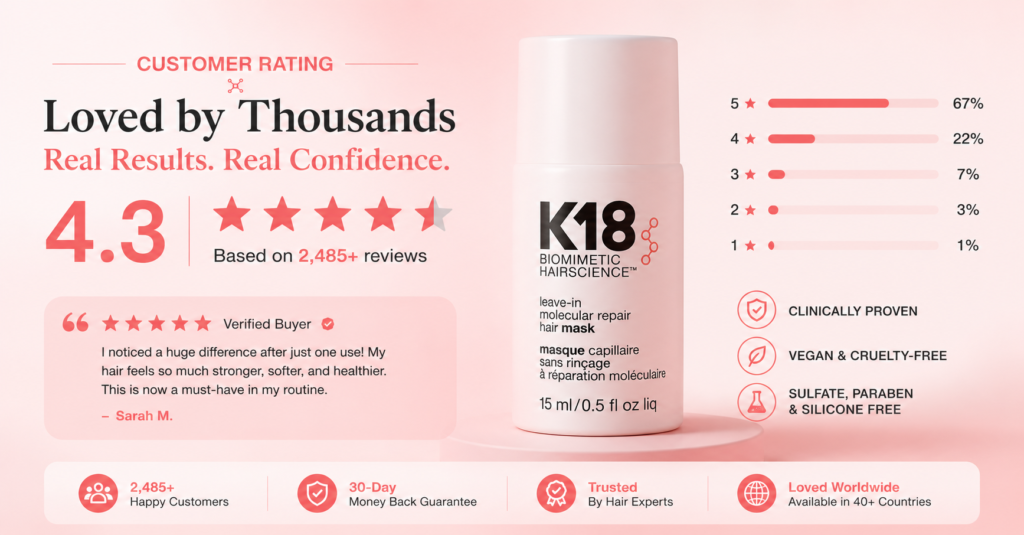
Our rating: 4.3 out of 5
Points deducted for the price, the limitation around thick and coily hair types, and the reality that it is genuinely ineffective for hair types it claims to serve. For chemically and heat-damaged hair — it earns every bit of its reputation.
Quick Reference Table
| Points | Details |
|---|---|
| Best for | Bleached, colored, heat-damaged hair |
| Key ingredient | K18Peptide™ (Lauroyl Tetrapeptide-30) |
| How to use | Leave-in after shampoo, no conditioner before, 4 min wait |
| Results timeline | First use for some; full repair after 6 washes loading phase |
| Sizes & price | Mini $12–14 / Small $29 / Full size $75 |
| NOT suitable for | Healthy hair, thick coily hair needing conditioner, severe damage |
| vs. Olaplex | Faster, deeper repair vs. ongoing maintenance |
| Amazon rating | 4.6/5 stars — 3,600+ reviews |
| Salon recommended | Yes — used by professional stylists worldwide |
| 🛒 Buy on Amazon | 👉 Check current price here |
Frequently Asked Questions
Can I use K18 on color-treated hair? Yes K18 is specifically designed for color-treated hair. It is safe to use immediately after coloring or highlighting services.
Can I use K18 every wash? During the six-wash loading phase, yes. After that, once every four to six washes is the recommended maintenance frequency to avoid buildup.
Does K18 work on natural, undamaged hair? The repair effect requires broken bonds to work on. Results on undamaged hair are minimal. K18 is a treatment for damaged hair, not a general conditioner.
Can I use conditioner after K18? Yes conditioner, leave-in treatments, and styling products can all be applied over K18 after the four-minute treatment window. The restriction is only on using conditioner before K18.
Is K18 safe during pregnancy? The brand does not list any pregnancy-specific restrictions. However, as with any new product during pregnancy, consult your doctor if you have concerns.
What is the difference between K18 and Olaplex? K18 repairs polypeptide chains (the deeper structure) in four minutes as a leave-in. Olaplex repairs disulfide bonds in a rinse-out format. Both are effective K18 is better for acute severe damage, Olaplex for ongoing maintenance.
Does K18 make hair smell good? The scent is very subtle — not perfumed or strong. Most users describe it as barely noticeable.